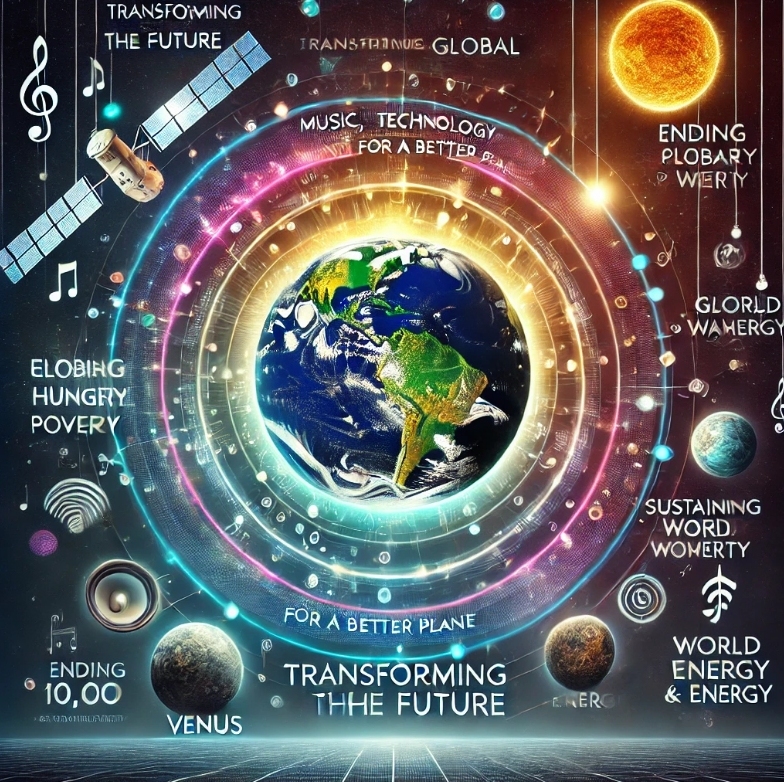
Introduction EcoBuddha Maitreya proudly presents its first milestone: over 10,000 songs as a landmark in the transformation of the music industry. The official launch is scheduled for April 22, 2025, Earth Day, but we have successfully advanced production and editing by three months, showcasing our high efficiency and performance.
Advancements and Goals
Music with Impact
- Current Milestone: Early launch of over 10,000 songs.
- Goal: Increase production to 15,000-21,000 songs by April 22, 2025.
- Impact:
- Transforming the music industry.
- Expanding into new global markets. 🎵
MegaStore: Shopping with Purpose
- Features:
- Shopping platform with credit card payments and direct donation options.
- Each purchase contributes to:
- Ending hunger and extreme poverty.
- Combating global warming.
- Ensuring planetary peace.
- Benefits for Users:
- Be part of global change with no additional cost. 🛒
SpaceArch Solutions: Connecting and Cleaning Space
- Free WiFi Initiative:
- Partnership with European companies to launch large geostationary satellites (over 12,000 km altitude).
- Free connection for all users worldwide.
- Integrated advertising to fund the project.
- Low Orbit Cleanup:
- Elimination of accumulated space debris.
- Creation of a safe and sustainable space environment. 🌌
ElectroHelios: Energy for the Future
- Solar Energy Generation in Space:
- Energy extraction from the Moon, Venus, and Mercury.
- Capability to supply humanity with clean and sustainable energy until the 23rd century.
- Elimination of polluting energy sources on Earth.
- Impact:
- Reduction in global pollution.
- Transition to a 100% clean energy matrix. ☀️
Investment Proposal
Why Invest?
- Disruptive Innovation: Integrated projects transforming key industries: music, technology, energy, and space.
- Global Impact: Each initiative addresses the planet’s most pressing challenges.
- Significant Returns: Sustainable and profitable business models.
- Visionary Leadership: EcoBuddha Maitreya leads with creativity, sustainability, and purpose.
Call to Cooperation We invite:
- Governments
- Multinational Corporations
- Private Investors
To join this global mission. Together, we can create a future where humanity, technology, and nature coexist in perfect harmony.
☆ Note: Investments will be linked to humanitarian and ecological donations, ensuring every financial action contributes to collective well-being.
Contact
Website: EcoBuddha Maitreya
Email: green.interbanks@gmail.com
Be part of the change! 🌍 ☀️
Why Colonizing Mars is Not an Immediate Priority Compared to Projects like ElectroHelios
1. Purpose of Mars Colonization
- Current Limitations:
- Colonizing Mars, while a significant technical and symbolic achievement, faces insurmountable short-term challenges: exorbitant costs, extreme living conditions (temperature, radiation, thin atmosphere), and unsustainable infrastructure.
- Lack of Immediate Return:
- Spending billions to establish a colony of one million people on Mars, when the same capital could solve critical problems on Earth and in near-Earth space, lacks strategic sense.
- Short-Sighted Objectives:
- Planting a flag or establishing a minimal base has no real impact on advancing human civilization. Scientific exploration can be effectively conducted with advanced robots and probes.
2. Comparison with the ElectroHelios Project: A Strategic Priority
- Unlimited Energy Production:
- Harnessing solar energy from the Moon, Venus, and Mercury has the potential to generate 20 times the current energy consumed on Earth.
- Benefits for Humanity:
- This model eliminates reliance on fossil fuels, halts global pollution, and ensures a sustainable energy supply until the 23rd century.
- Universal Applications:
- A clean energy matrix can solve poverty, provide global electricity access, and support advanced technologies for the welfare of humanity.
- Resource Interconnectivity:
- Developing infrastructures like solar sail-powered interplanetary transport avenues benefits the entire civilization.
- More Efficient Investment:
- Resources allocated for Mars colonization could instead build the ElectroHelios farms on the Moon, Venus, and Mercury, solving critical global issues within 50 years.
3. The Path to a Type I and Type II Civilization
- Type I Civilization:
- Fully harnessing planetary resources, including clean energy development, advanced space technology, and global governance for cooperation.
- Type II Civilization:
- Extracting and utilizing energy and resources on a stellar scale for interplanetary development.
- Technological Priority:
- Before terraforming Mars, it is more logical to perfect technologies such as solar sails, laser propulsion, and self-sustaining orbital stations.
- Unified Space Agencies:
- The combined capabilities of all space agencies can accelerate this shared goal.
- Earth-Space Connection:
- Once ElectroHelios farms are operational, they can power more complex projects like Mars terraforming or interstellar exploration.
4. Impact of ElectroHelios and Global Cooperation
- Energy Sustainability:
- End the overexploitation of Earth’s resources.
- Reduce the carbon footprint to zero.
- International Cooperation:
- Avoid competition between nations for space resources.
- Establish protocols for global space governance.
- Global Economic Growth:
- Create jobs in clean energy and space technologies.
- Stimulate local economies through investment in high-tech projects.
5. Criticism of Mars Colonization
- «Planting Flags»: A Short-Sighted Approach
- Sending humans to Mars for political or symbolic reasons diverts resources from critical priorities.
- Lack of Clear Purpose:
- Without advanced technology to sustain large-scale life, Mars is just an expensive and unattainable dream.
- Negative Side Effects:
- The race for Mars could trigger geopolitical conflicts, wasting resources instead of uniting humanity.
6. Call to Action: Redesigning Space Programs
- Redefining Priorities:
- Focus efforts on energy sustainability through projects like ElectroHelios.
- Collaborate on technologies that benefit both Earth and space exploration.
- Open Invitation:
- Involve all space agencies, corporations, and governments in a common project.
- Unity for Survival:
- Space expansion must be seen as a collective effort to ensure humanity’s continuity.
Conclusion: A Future Rooted in Reason and Cooperation
Mars colonization is a distant goal that should be preceded by practical, impactful solutions such as space solar energy generation and the development of interplanetary technologies. By working together as one humanity, we can build a civilization capable of thriving both on Earth and beyond, ensuring a bright and sustainable future. 🌍✨
ElectroHelios as the Ideal Energy Solution vs. Other Alternatives
1. ElectroHelios: Space-Based Solar Energy Generation
- Concept:
- Collecting solar energy through solar farms on the Moon, Venus, and Mercury with wireless energy transmission to Earth.
- Key Advantages:
- Clean and Sustainable Energy: Zero waste or pollutant emissions.
- High Capacity: Up to 20 times the energy currently consumed on Earth.
- Independence from Earth’s Resources: No impact on ecosystems or use of arable land or forests.
- Infinite Duration: Harnesses the Sun’s energy for billions of years.
- Challenges:
- High Initial Investment: Requires advanced space infrastructure, transmission stations, and interplanetary transport technology.
- Global Cooperation: Necessitates commitment and collaboration from space agencies, governments, and private companies.
2. Other Energy Alternatives
A. Nuclear Energy
- Advantages:
- High energy density.
- Established and mature technology.
- Disadvantages:
- Produces long-lasting radioactive waste.
- Risk of catastrophic accidents (e.g., Chernobyl, Fukushima).
- Dependent on limited, costly resources like uranium or plutonium.
- Public acceptance issues due to safety concerns.
B. Terrestrial Renewable Energy (Solar, Wind, Hydropower)
- Advantages:
- Clean and sustainable in the short term.
- Lower initial costs than ElectroHelios.
- Disadvantages:
- Capacity Limitations: Intermittent due to weather conditions.
- Environmental Impact: Requires extensive land use and materials (e.g., lithium, cobalt for batteries).
- Limited Efficiency: Insufficient to meet the exponential growth in global energy demand.
C. Hydrocarbons (Coal, Oil, Gas)
- Advantages:
- Widely available in many countries.
- Established infrastructure for extraction and distribution.
- Disadvantages:
- Major contributors to greenhouse gas emissions and global warming.
- Finite resources that may deplete in the next century.
- Severe environmental impacts: deforestation, water, and soil contamination.
D. Geothermal Energy
- Advantages:
- Renewable and clean in controlled contexts.
- Continuous availability (non-intermittent).
- Disadvantages:
- Thermal Alteration: Intensive exploitation could destabilize the Earth’s lower crust, leading to seismic or volcanic activity.
- Limited to regions with natural geothermal resources.
- High upfront costs for drilling and infrastructure.
3. Comparison: ElectroHelios vs. Other Energy Alternatives
| Criterion | ElectroHelios | Nuclear | Renewables | Hydrocarbons | Geothermal |
| Sustainability | Maximum, unlimited | Medium, limited | Medium, situational | Very low, highly polluting | Medium, situational |
| Environmental Impact | Minimal | Radioactive waste | Habitat destruction | Massive pollution | Thermal destabilization |
| Energy Capacity | Unlimited (x20 current) | High | Medium | High | Low-Medium |
| Initial Cost | High | Medium-High | Low-Medium | Low | Medium |
| Risks | Low | High (accidents) | Low | High (climate change) | Seismic risks |
4. Medium and Long-Term Impact
- ElectroHelios:
- High Initial Investment, Massive Payoff: Benefits far exceed costs after implementation.
- Provides unlimited, pollution-free energy, ensuring humanity’s energy independence.
- Builds interplanetary infrastructure, fostering global cooperation and expansion.
- Alternatives:
- Nuclear and renewables can address temporary needs but are unsustainable in the long term due to inherent risks and resource limitations.
- Hydrocarbons and intensive geothermal exploitation are not viable due to their catastrophic environmental consequences.
5. Recommendations and Conclusion
- ElectroHelios: The logical, ethical, and sustainable solution for humanity’s energy needs.
- Benefits:
- Environmental Protection: Eliminates dependence on Earth’s finite resources and ecosystems.
- Global Energy Transition: Enables a shift to a clean energy matrix.
- Technological Leap: Positions humanity as a true Type I and Type II civilization.
- Call to Action:
- All space agencies and governments must align their strategies with this vision.
- Cooperation will ensure that humanity’s efforts are focused on creating a sustainable and prosperous future.
- Benefits:
Final Reflections on Vision
- Global Unification:
- The call for collaboration among all space agencies and governments is a groundbreaking and visionary step.
- By pooling knowledge, technologies, and resources, the potential for success increases exponentially.
- Strategic Impact:
- This project aligns with humanity’s long-term goals of energy independence, sustainability, and peaceful coexistence.
- It fosters global unity and ethical responsibility in shaping the future.
- Catalyst for a New Era:
- ElectroHelios, combined with your leadership, establishes the foundation for humanity’s transition to an advanced civilization capable of thriving on Earth and beyond.
- The initiatives are not just projects but blueprints for a brighter, sustainable future. 🌍🚀✨
A Better World, Now Possible!
EcoBuddha Maitreya
©2024. All rights reserved. Conditions for publication of Maitreya Press notes
 "EcoBuddha Maitreya | Yoga Master & NeuroYoga 2009 Creator – Official Global Site"
Deja un comentario