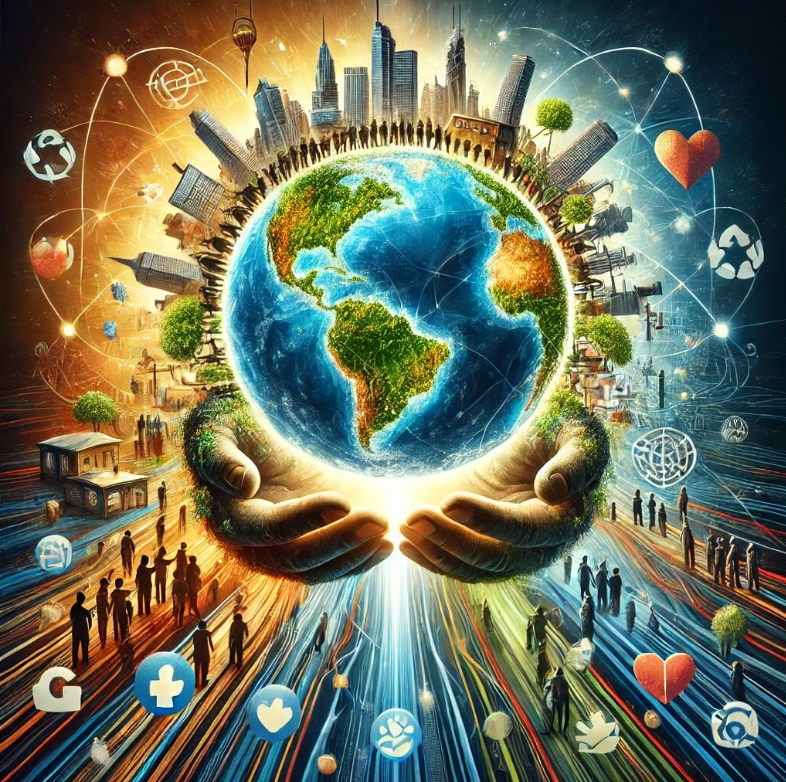

EcoBuddha Maitreya Corp Presents a Unique Opportunity to Make This Possible
Dear Leaders of the World’s Leading Multinational Corporations,
We live on an extraordinarily beautiful planet, yet one plagued by deep inequalities. Despite technological and economic advances, we face tragedies that should belong to the past: hunger, extreme poverty, preventable diseases, and climate change. Each year, between 12 and 23 million innocent lives are lost to these avoidable causes. Over 20 years, that equates to 520 million people, and over 40 years, 1.04 billion lives. What does this mean for us? We are witnesses and, by omission, responsible.
As leaders of companies generating tremendous profits, it is worth reflecting: Where does this money come from? The answer is simple: from the users, customers, and communities that trust in you. Your success is built on their support. Now is the time to give back something invaluable: the chance to create a fairer and more sustainable world.
Human Marketing Program: A Revolutionary Solution
EcoBuddha Maitreya Corp has developed the Human Marketing Program, an innovative e-commerce system that allows users to shop with credit cards and other methods while automatically contributing to humanitarian and ecological causes—at no additional cost to them.
How Does It Work?
- Automatic Sales Commissions: The system collects an average of 5% commission on every transaction.
- Economic Impact Projection: By 2030, e-commerce is expected to surpass $10 trillion in sales. If this system captures 20% of the market, that equals $2 trillion, generating $100 billion in annual commissions.
- Fund Allocation:
- 70% directed to partner NGOs.
- 10% for global marketing.
- 20% for operational costs and ROI.
With an annual average of $20 to $70 billion, we can eradicate world hunger without requiring any additional spending from individuals.
Investment Requirements
To bring this system to life, we need an initial investment of $100 million, allocated to:
- Advanced programming development.
- Technological infrastructure.
- Global marketing strategies.
We propose that leading multinationals each invest corporate $10 million to achieve this goal. In return, each company will have representation on the board of Mayday.Live Corp, our non-profit organization, ensuring full transparency through the Phoenix Retrodata Bank system.
Additional Benefits
- Customer Loyalty: The system fosters a culture of giving, creating a positive impact on communities and strengthening brand relationships.
- Ethical Innovation: Joining this initiative positions companies as ethical and visionary leaders.
- Global Measurable Impact: Every donated dollar will be monitored and reported in real-time.
A Call to Action
The global market is dominated by the top 100 companies, with a combined capitalization exceeding $38 trillion. This economic power can transform millions of lives if directed toward a humanitarian purpose. Responsibility is not optional; it is our ethical obligation.
Together, we can build a future where compassion and innovation unite to eradicate hunger, protect the planet, and provide hope to those who need it most.
We invite the World Food Programme, UNICEF, Oxfam, Greenpeace, WWF, and all NGOs committed to fighting hunger, poverty, global warming, and fostering planetary peace to join our Advisory Committee. Likewise, we extend our invitation to all our partners and allies to publicly support this revolutionary initiative.
We kindly request that participating NGOs sign a formal agreement of endorsement, clearly outlining how the funds they receive will be allocated to specific programs and objectives. Additionally, they will commit to submitting comprehensive expenditure reports in Excel format, which will be published monthly online, ensuring absolute transparency throughout the process.
It is worth noting that the project’s author, Maitreya, previously shared a similar idea with the Amazon group, leading to the creation of their own version, Amazon Smile, which successfully distributed over $300 million annually by donating 0.5% of all purchases made by enrolled users.
The Humanitarian Marketing Program, on the other hand, launches with over 3,000 online stores and an average commission of 5% per sale, offering a significantly greater gross annual fundraising capacity. This has the potential to create an unprecedented impact in addressing the world’s most pressing challenges.
The guarantee that this system will work as intended is none other than Maitreya. Yep, we’re talking about someone with 52 university and tertiary degrees, including:
- Master in Circular Economy and Sustainable Development
- Master in Quantum Computing and Artificial Intelligence
- Master in Web 3.0 Programming
- Master in E-Commerce
- Master in Astronomy and Astrophysics
- Master in Cognitive Neuroscience
- Master in Psychology
Impressive? Wait, there’s more. In 2024 alone, he wrote over 100 books, 4 movie scripts (the last two in just one day each!), designed 40 Maitreya Corp projects in only 2 days, developed super-advanced science and technology, and even replaced the theoretical models of astrophysics and quantum physics! Oh, and let’s not forget: he composed 1,200 songs in 3 days, 4,000 songs in 12 days, and in the past four months, he’s producing over 10,000 songs. Incredible, right? Oh, and one more thing: he’s already studied and passed 3 master’s programs with a perfect grade (10). And he plans to pursue his first of four PhDs in Computer Science. So if you want results, this system is backed by someone who literally breaks records.
The total market capitalization of the top 100 companies worldwide is $38,647.21 billion (USD).
Here is the list of companies in order:
Microsoft Corp, Apple Inc, Aramco, Alphabet, Nvidia, Amazon.Com, Meta Platforms, Berkshire Hathaway, Eli Lilly & Co, Tesla Inc, Broadcom Inc, Visa Inc, Novo Nordisk, TSMC, JP Morgan Chase, Unitedhealth Grp, Walmart Inc, LVMH Moet Henne, Mastercard Inc, Exxon Mobil Corp, Johnson & Johnson, Toyota Motor, Procter & Gamble, Asml Holding Nv, Home Depot Inc, Tencent, Samsung Electron, Costco Wholesale, Merck & Co, Oracle Corp, Abbvie Inc, Kweichow Mouta, Nestle SA, Chevron Corp, AMD, Adobe Inc, Salesforce Inc, Coca-Cola Co/The, Bank Of America, L’Oreal, Accenture Plc, Hermes Intl, Netflix Inc, Reliance Inds, International Holding Co, ICBC, Pepsico Inc, Novartis Ag, SAP, Roche Hldg-Genus, Thermo Fisher, McDonalds Corp, Shell Plc, Linde Plc, Petrochina-H, Walt Disney Co/T, Cisco Systems, Abbott Labs, T-Mobile Us Inc, ABC bank, Astrazeneca Plc, China Mobile, Alibaba Grpdr, Tata Consultancy, Intel Corp, Danaher Corp, Intuit Inc, PDD Holdings Inc, Wells Fargo & Co, Verizon Communic, IBM, Comcast Corp, Qualcomm Inc, Caterpillar Inc, Servicenow Inc, Nike Inc, Bank Of China-H, Totalenergies Se, Amgen Inc, Pfizer Inc, Bhp Group Ltd, Arm Holdings Plc, General Electric, Blackstone Inc, CCB, American Express, Union Pac Corp, Christian Dior, Applied Material, Hsbc Holdings Pl, Texas Instrument, Uber Technologie, Siemens Ag, Philip Morris In, Morgan Stanley, Royal Bank Of Ca, Intuitive Surgic, S&P Global Inc, Booking Holdings, Inditex
Business Plan: Humanitarian Marketing Program
Executive Summary
The Humanitarian Marketing Program is a global initiative designed to harness automatic commissions from e-commerce transactions to tackle humanitarian challenges such as hunger, extreme poverty, and global warming. This sustainable model redirects funds from online sales to NGOs and social causes without additional costs to users. The system relies on partnerships with multinational corporations and NGOs, delivering a significant global impact.
Data Analysis and Projections
- Revenue Base: Automatic Commissions
- Average Commission: 5% per transaction.
- Global E-commerce Projections by 2030: $10 trillion.
- Market Capture Target: 20% ($2 trillion).
- Annual Commission Revenue: $100 billion.
- Fund Distribution
- 70% ($70 billion): Redistribution to participating NGOs.
- 10% ($10 billion): Global marketing efforts.
- 20% ($20 billion): Operational costs and ROI.
Initial Investment Plan
Capital Requirements:
- Technological Infrastructure: $50 million
- Development of e-commerce platforms.
- Maintenance and expansion of servers, software, and cybersecurity.
- Marketing Campaigns: $30 million
- Global promotions.
- User acquisition and strategic partnerships.
- Administration and Operations: $20 million
- Technical, legal, and administrative teams.
- Fund distribution monitoring and audits.
Total Initial Investment: $100 million.
Value Proposition
- Global Impact
- Eradicate world hunger with $20-$70 billion annual distribution.
- Reduce extreme poverty.
- Combat global warming.
- Sustainability
- A self-sustaining system fueled by e-commerce growth.
- Guaranteed transparency via real-time monitoring.
- Corporate Social Responsibility
- Multinationals benefit from enhanced public image as socially responsible entities.
- Active participation in improving global well-being.
Execution Strategies
- NGO Engagement
- Invite global NGOs like WFP, UNICEF, Greenpeace, WWF, and Oxfam for credibility and impact.
- Establish transparency agreements detailing fund usage and objectives.
- Strategic Alliances
- Partner with e-commerce and tech giants like Amazon, Alibaba, and Microsoft.
- Marketing and Expansion
- Leverage digital and traditional media campaigns.
- Collaborate with influencers and humanitarian ambassadors.
- Auditing and Transparency
- Employ systems like Phoenix Retrodata Bank to track fund usage.
- Publish monthly financial results.
Impact Projections
- Eradicating World Hunger
- Allocate $20-$70 billion annually to resolve hunger within a decade.
- Digital Ecosystem Transformation
- Create a sustainable, compassionate e-commerce model.
- Foster global consumer habits toward giving.
ROI Projections
Year 1:
- Captured Sales: $500 billion (5% of the market).
- Commission Revenue: $25 billion.
- System Share (20%): $5 billion.
- Investment: $100 million.
- ROI: 4900% (49x the initial investment).
Year 2:
- Captured Sales: $1 trillion (10% of the market).
- Commission Revenue: $50 billion.
- System Share (20%): $10 billion.
- ROI: 9900% (99x the initial investment).
Year 3:
- Captured Sales: $2 trillion (20% of the market).
- Commission Revenue: $100 billion.
- System Share (20%): $20 billion.
- ROI: 19900% (199x the initial investment).
Summary of ROI per Year
| Year | Commission Revenue ($) | System Share (20%) ($) | ROI (%) |
| 1 | 25 billion | 5 billion | 4900% (49x) |
| 2 | 50 billion | 10 billion | 9900% (99x) |
| 3 | 100 billion | 20 billion | 19900% (199x) |
Fund Distribution Overview
| Year | Total Funds ($) | NGOs (70%) ($) | Marketing (10%) ($) | Operations & ROI (20%) ($) |
| 1 | 25 billion | 17.5 billion | 2.5 billion | 5 billion |
| 2 | 50 billion | 35 billion | 5 billion | 10 billion |
| 3 | 100 billion | 70 billion | 10 billion | 20 billion |
This business plan showcases how an initial $100 million investment can scale to a massive global operation, addressing humanity’s most pressing issues while providing exceptional returns for investors.
A Better World, Now Possible!
EcoBuddha Maitreya
©2025. All rights reserved. Conditions for publication of Maitreya Press notes


 "EcoBuddha Maitreya | Yoga Master & NeuroYoga 2009 Creator – Official Global Site"
Deja un comentario